Need for and scope of continuous remote monitoring
Water quality monitoring is essential for understanding estuarine ecosystem processes and detecting changes that could affect the health of the ecosystem and neighboring communities. In addition to identifying threats, this monitoring allows for the evaluation of the effectiveness of implemented management actions and provides essential information for designing and integrating mitigation and protection strategies.
Limitations of traditional sampling and the value of continuous remote monitoring
Traditionally, water quality data collection is carried out through field visits under favorable conditions: daytime, without rain, and with minimal waves. For safety reasons, measurements are not possible during heavy rain or storms. Thanks to a remote monitoring system that collects data continuously—day and night, even in adverse conditions—information that would otherwise be inaccessible can be obtained.
Changes in water quality caused by accidents, pollutants, or extreme weather events occur rapidly and unpredictably. Continuous remote monitoring systems document these changes in real time, facilitating a better understanding of ecosystem processes, the detection of sudden water quality declines, and timely responses to protect the ecosystem.
Tool details
The system uses monitoring buoys (DB 600 Xylem) equipped with multiparameter sensors (YSI EXO 2s Sonde) that measure water quality indicators, such as dissolved oxygen, turbidity, pH, temperature, and microalgae concentration, among others. Data is transmitted using technology similar to that of cell phones, and the system operates on solar power. This allows for 24/7 access to the information via a digital application (Hydrosphere), available on mobile phones, tablets, or computers. The system generates records every 15 minutes, enabling precise assessment of the water body's health.
Predictive tools and analytical models
The collected data feeds predictive models that allow for anticipating events such as microalgal blooms, which can produce toxins harmful to water quality and aquatic life. The accuracy and usefulness of these models depend directly on the quality, continuity, and resolution of the data collected by continuous remote monitoring systems.
Collaboration and data integration
Thanks to the integration of information from various government entities and agencies, this collaborative effort allows for a comprehensive view of the estuarine ecosystem. Data shared on a common platform facilitates regular analysis, continuous communication, and evidence-based decision-making, strengthening the capacity to respond to changes and extreme events.
Location of observation systems
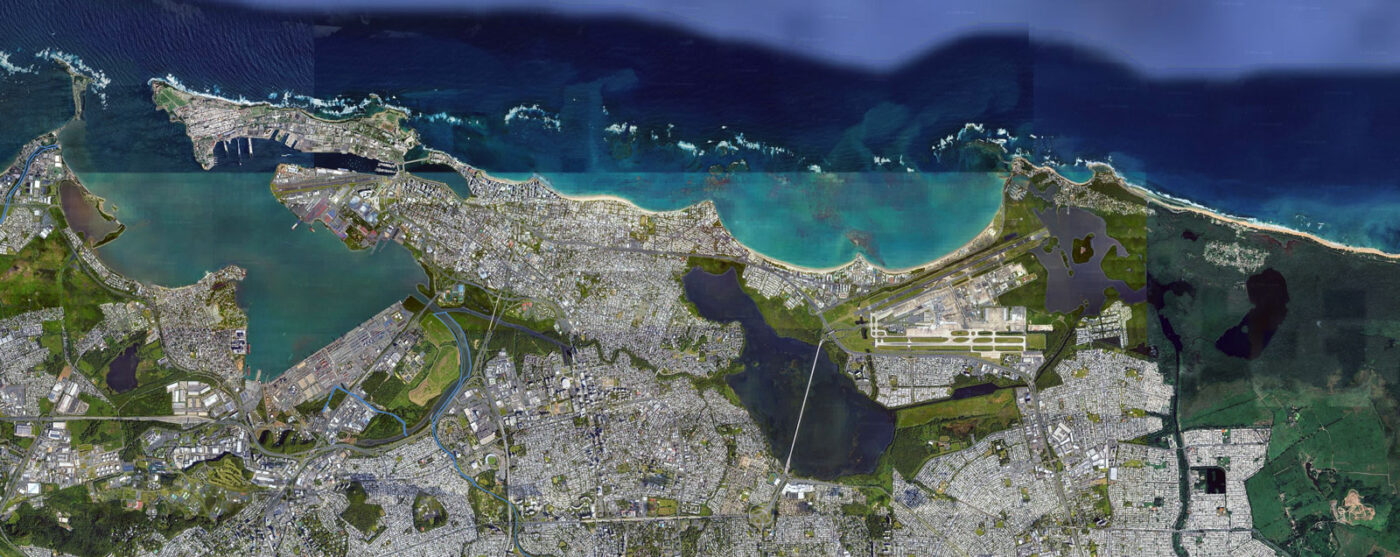
The continuous remote monitoring system will have five buoys equipped with sensors, installed at strategic points in the San Juan Bay Estuary (see Table 1).
Table 1. Water bodies and geographical location of continuous remote monitoring systems.
Body of water | Latitude | Long Jump |
|---|
Laguna del Condado Estuarine Nature Reserve | 18.458241 | -66.080153 |
river stones | 18.424270 | -66.080916 |
Martín Peña Canal | 18.432777 | -66.060833 |
San José Lagoon | 18.424166 | -66.023611 |
La Torrecilla Lagoon | 18.444104 | -65.981107 |
The selection of locations was based on the following criteria:
- Representativeness: that the point adequately represents the body of water, preferably close to the physical center of the system.
- Bathymetry: sufficient depth to prevent the sensors from coming into contact with the bottom sediments.
- Security: visibility of the systems from the shore to reduce risks of vandalism or loss.
- Accessibility: ease of access for performing maintenance and periodic calibration.